Mount Edgcumbe House & Country Park
| Contact | The Secretary |
| Enquiries | 01752 822236 |
| Fax | 01752 822199 |
| mt.edgcumbe@plymouth.gov.uk | |
| Website | www.mountedgcumbe.gov.uk |
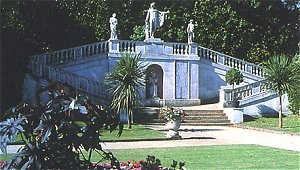
| An 18th Century garden owned by Cornwall County Council and Plymouth City Council. A grade I landscape overlooking the Plymouth Sound. Features classical garden houses, statues and the exotic Shell Seat. | |
| Open | House and Earls Garden open 23rd March - 20th Sept.. Sun to Thurs & BH's, 11.00-16.30. Formal Gardens, Country Park, National Camellia Collection open all year. (Cafe limited in winter.) |
| Admission | For House & Earls Garden: Adults: £6.00, 5-15s: £3.50, Seniors & Disabled: £5.00, Disabled: Carer Free, Family £12.50, Pre-arranged parties: £5.00 pp, (10+, max 40) |
Mount Edgcumbe House was the Tudor home of the Earls of Mount Edgcumbe with views over the Plymouth Sound and the river Tamar. The Majestic Pleasure Gardens and the Park at Mount Edgcumbe are English Heritage Grade I listed. Mount Edgcumbe is also home to the National Plant Collections for Camellia.
By the end of the 15th century the Durnford family had acquired a large land holding in the area and Stephen Durnford owned the estates in Stonehouse, Plymouth, Maker, and Rame. (It is the Rame Peninsula is where Mount Edgcumbe was to be built.)
In 1493 Sir Piers Edgcumbe of Cotehele married Joan Durnford heiress to the Durnford family estates and in 1515 Sir Piers was given permission by King Henry VIII to empark deer.
Sir Piers created a deer park at Mount Edgcumbe and in 1547 his son Richard engaged Roger Palmer, a local mason, to build a new house high on the hill overlooking the Tamar and the Plymouth Sound. The house was built to a compact rectangular plan with a central top-lit hall and circular corner towers.
In 1749, the corner towers were altered into their present octagonal form by Richard, 1st Lord Edgcumbe. His son, an admiral, became 1st Earl of Mount Edgcumbe in 1789. The 1st Earl and his son the 2nd Earl between them transformed the grounds into one of the finest landscape gardens in England and they remain largely unchanged today.
Scattered throughout the Park are buildings - Thomson's Seat, Milton's Template, the Folly, the Arch - consciously sited to create views and atmosphere. Individual trees and plantations are placed to enhance a magnificent setting above Plymouth Sound and the River Tamar. Woodlands contain specimen trees such as Californian Redwood and Stone pines, and provide shelter for the herd of wild fallow deer.
In 1750 work began on the Formal Gardens on the site of the former wilderness gardens. The Formal Gardens (10 acres) in front of the house and to the right of the main drive (looking out from the House) include English, French (Regency), Italian (made in the 1790s) together with the modern New Zealand (1989) and American Gardens (1989) and The Jubilee Garden (2003) which was established to commemorate Queen Elizabeth II's Golden Jubilee together with Rose Gardens, the Great Ilex hedge, the Block House and Battery, 18th century Thomson's Seat overlooking the river Tamar and the Orangery (c.1760) which is now a restaurant.
The 2 acre Earls Gardens include a mixture of formal and semi formal features, from the East Lawn with it's own summer house next to the House, the Cedar Lawn, with its own summer House and the Victorian Shell seat and Cedar View seat. There is also a 400 year old lime-tree.
Most of the house was destroyed by fire following a bombing raid during World War II in 1941. Miraculously the walls of this red stone Tudor House survived a direct hit by bombs though most of the Family and Estate papers were destroyed by the fire.
The building remained a ruin until 1958 when the 6th Earl of Mount Edgcumbe commissioned Adrian Gilbert Scott to rebuild it using a steel frame and concrete floors. The rebuilding and restoration were completed in 1964.
In 1971 the house and 865 acres gardens and parkland were bought by Plymouth City Council and Cornwall County council and the grounds turned into a country park. The House was leased to the family. In 1987 the Family relinquished the lease and a refurbishment was undertaken by the new owners in preparation for the house to be opened to the public on a regular basis in 1988.
Mount Edgcumbe House & Country
Park
Cremyll
Torpoint
Cornwall
PL10 1HZ